Your hair is thinner than it used to be. Or you are finding a lot of it in the shower.
Those two things sound alike, but they are not the same problem. The pattern matters, because the cause and the timeline are different.
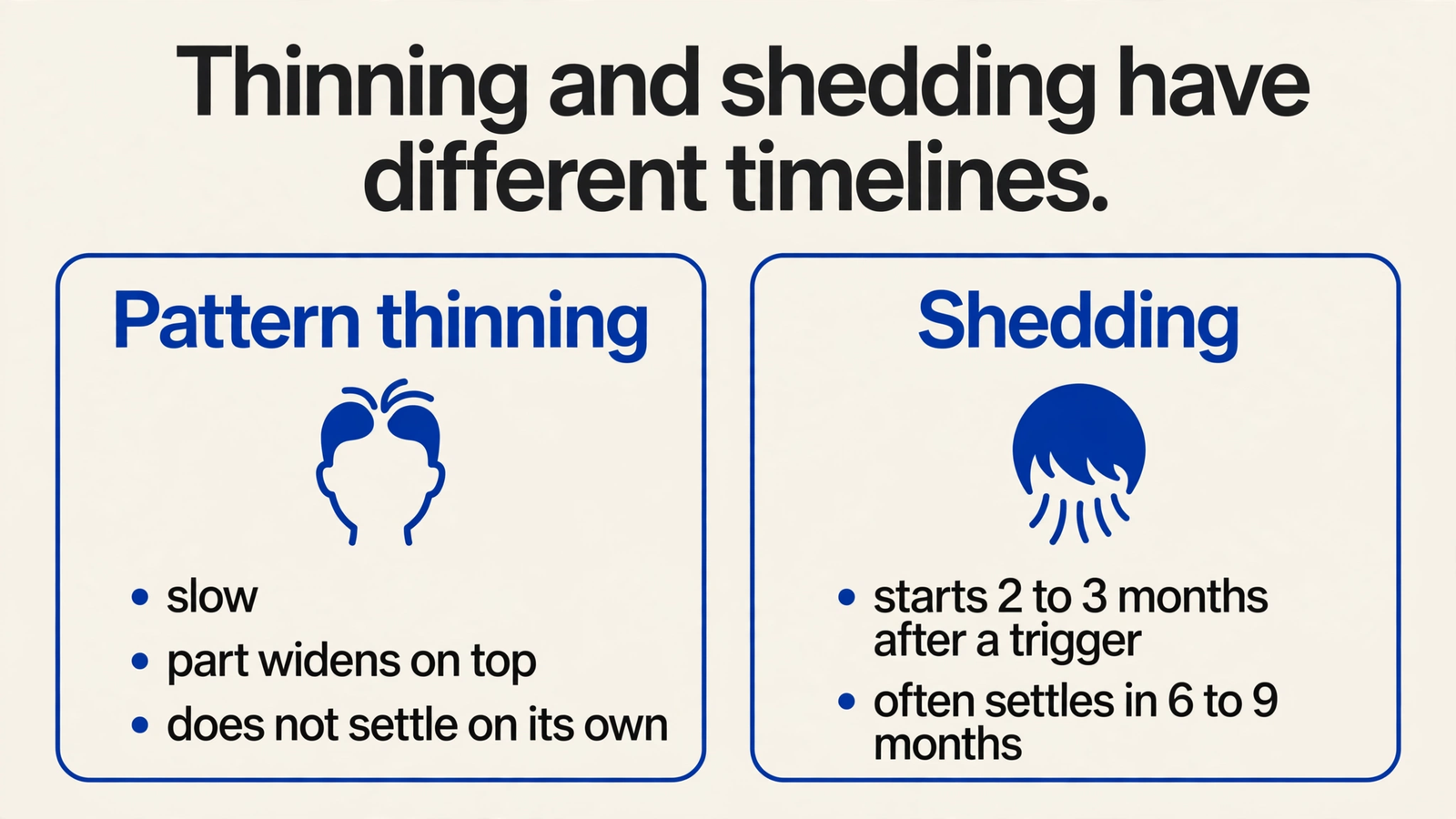
Female pattern hair loss is the most common non-scarring hair loss in women. It is slow. Follicles shrink over time, more hairs sit in the resting phase, and the hair cycle shortens. It shows as diffuse thinning over the top of the scalp, with the part widening. The frontal hairline is usually kept. It does not lead to complete baldness the way male pattern loss can.
It gets more common with age. In Caucasian women, about 3 to 12 percent in their 30s and 40s, 14 to 28 percent after menopause in their 50s, and 29 to 56 percent over age 70. Only about one third of women with pattern hair loss have abnormal androgen levels. Hormone conditions linked to it include PCOS, high prolactin, and adrenal hyperplasia, and rarely ovarian or adrenal tumours.
Shedding is different
Telogen effluvium is shedding, not slow thinning. Hair shifts early into the resting phase and falls out, usually 2 to 3 months after a trigger. Triggers include stress, childbirth, surgery, infection, a drug, poor nutrition, or an endocrine problem. Losing 20 pounds or more can also be a trigger.
Shedding affects the whole scalp, most visibly at the temples. In the acute form, full regrowth is seen after 6 to 12 months, once the trigger has passed. Shedding usually settles over 6 to 9 months. Chronic shedding lasts 6 months or more. A shedding episode can also reveal pattern thinning underneath.
So the first question is not what to put on your scalp. It is which pattern you have. Slow thinning on top points one way. Hair falling all over, a few months after something changed, points another.
What is worth checking
Diagnosis is usually clinical. A magnified scalp look, called trichoscopy, shows miniaturization and varied hair thickness. A scalp biopsy is only needed when the diagnosis is uncertain, or scarring hair loss or alopecia areata is suspected.
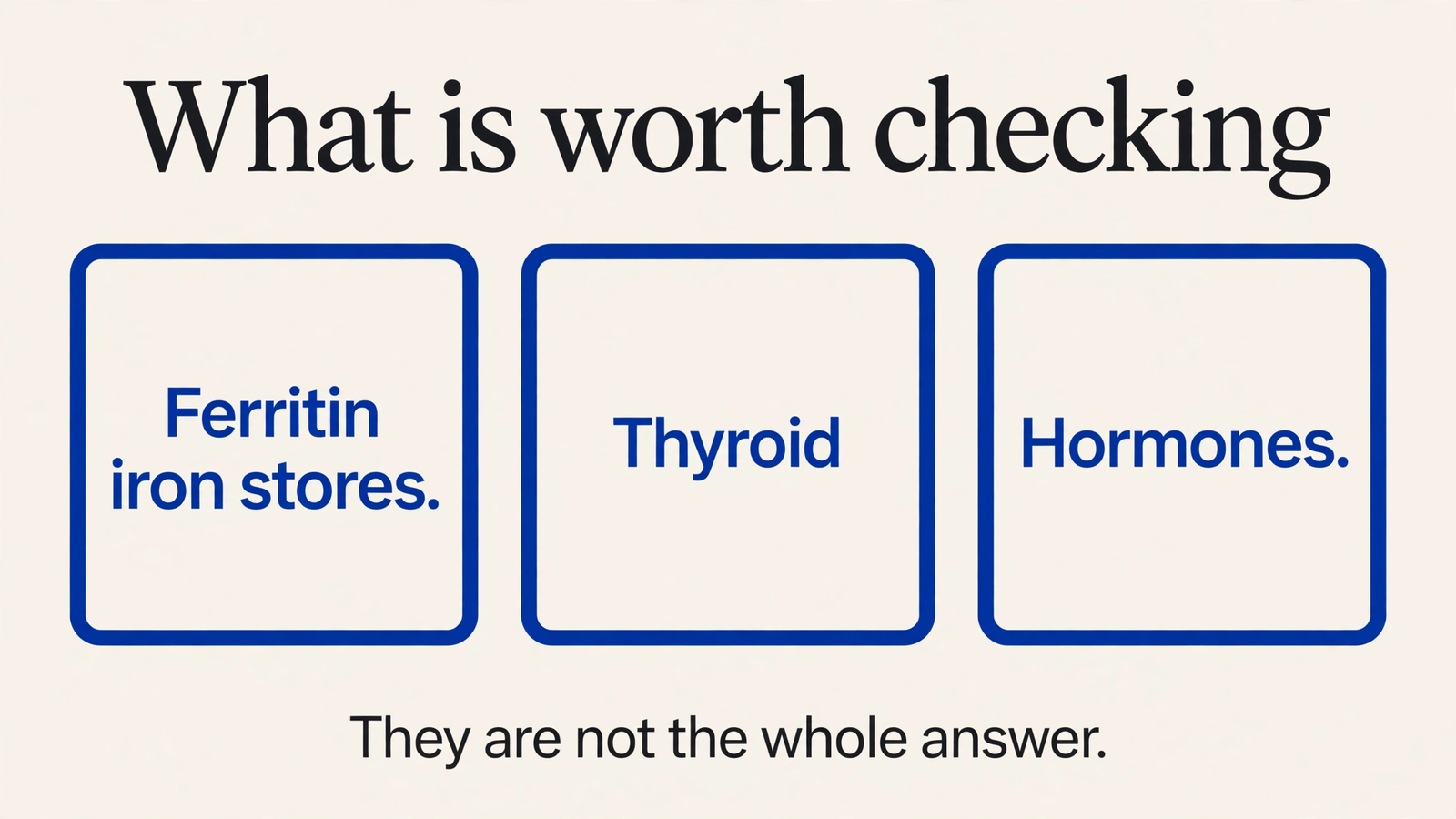
Blood iron, ferritin, vitamin D, zinc, and thyroid profile may be useful to assess other conditions that affect regrowth. Low iron, thyroid trouble, and hormone patterns are things to check, not the whole answer. Read more about ferritin here: “Your blood count is normal. So why are you exhausted?”
What the evidence actually says
Of the treatments studied for pattern hair loss, topical minoxidil has the strongest trial evidence. A meta-analysis found people on topical minoxidil were more likely to report clinically significant regrowth than placebo.takes at least 4 months to show a visible effect, and at least 12 months before concluding it does not work. Shedding in the first 2 to 8 weeks is common. Treatment is individualized, and it belongs in a conversation with your clinician.
Biotin is not a fix for pattern hair loss. It helps hair only where there is a real deficiency, and true deficiency is rare. A trial in women with diffuse shedding found no difference between biotin and placebo. High dose biotin can also skew lab tests, including troponin and thyroid tests.
Other treatments are coming into the market, and more research is needed before they can be called proven. Botanicals are one area, along with PRP, exosomes, and peptides. They are promising, not settled, and the research backing them is still building. That is why they are worth watching, and why they do not belong in this post as answers yet.
The part no one talks about
Hair loss affects how people feel. The review reports reduced quality of life, anxiety, and depression in women with female pattern hair loss. Early diagnosis matters, because pattern thinning is slowly progressive.
If your hair is thinning on top, slowly, over months or years, or if you are shedding a lot all over a few months after a trigger, talk it through with a clinician. The pattern, the timeline, and the labs together are what point to the cause.
Education only, not medical advice.
Dr. Shad Abdulla, ND
Blue Yarrow: Root causes. Real healing.
FAQ
Is thinning the same as shedding?
No. Pattern thinning is slow, with follicles shrinking and the part widening on top. Shedding is a lot of hair falling all over, usually 2 to 3 months after a trigger, and it often settles over 6 to 9 months.
Does biotin help hair loss?
Only with a real deficiency, which is rare. There is no good evidence it helps pattern hair loss, and high doses can skew lab tests.
Will fixing low iron fix my hair?
Not necessarily. Iron, ferritin, vitamin D, zinc, and thyroid are worth checking, but they are not the whole answer.
Sources: Starace et al 2020, Am J Clin Dermatol; UpToDate, Female pattern hair loss, Management, 2025-10-07; British Association of Dermatologists patient leaflet, updated Jan 2021, Oct 2024; American Academy of Dermatology, Mar 17 2023; 2017 review in Skin Appendage Disorders; 2024 review in Journal of Clinical and Aesthetic Dermatology; Gupta et al 2025, Med Sci (Basel); 14(1):5; Bikash 2025, Int J Trichology; 17(1):13-19.

Dr. Shad Abdulla, ND
Licensed naturopathic doctor in Arizona and California. Currently in residency at Bastyr University in San Diego. The Blue Yarrow blog is education only. It is not medical advice, and it does not replace care from your own doctor.
