The "Rogue Factory" in Your Middle: Why the Science of Cortisol Belly Defies Standard Diet Logic
In my clinical experience, some of the most frustrated patients I treat are those who have been the most disciplined. They arrive in my office having followed a "flawless" routine: a meticulously tracked 1,200-calorie diet paired with five days a week of dawn high-intensity interval training (HIIT).
By every rule of standard fitness math, the weight should be melting off. Instead, they find their waistbands tightening while their arms and legs grow thinner. To make matters worse, they often bring in a "perfectly normal" 8:00 AM blood test result, only to be told by a previous provider to simply "try harder."
What I tell these patients is that they aren't losing their minds, and their willpower isn't the problem. Their biological machinery has been hijacked. This isn't a failure of math; it is a clinical phenomenon where the body’s stress response has moved beyond the brain and established a "rogue factory" directly in the midsection.
The 11β-HSD1 Enzyme: Localized Currency Printing
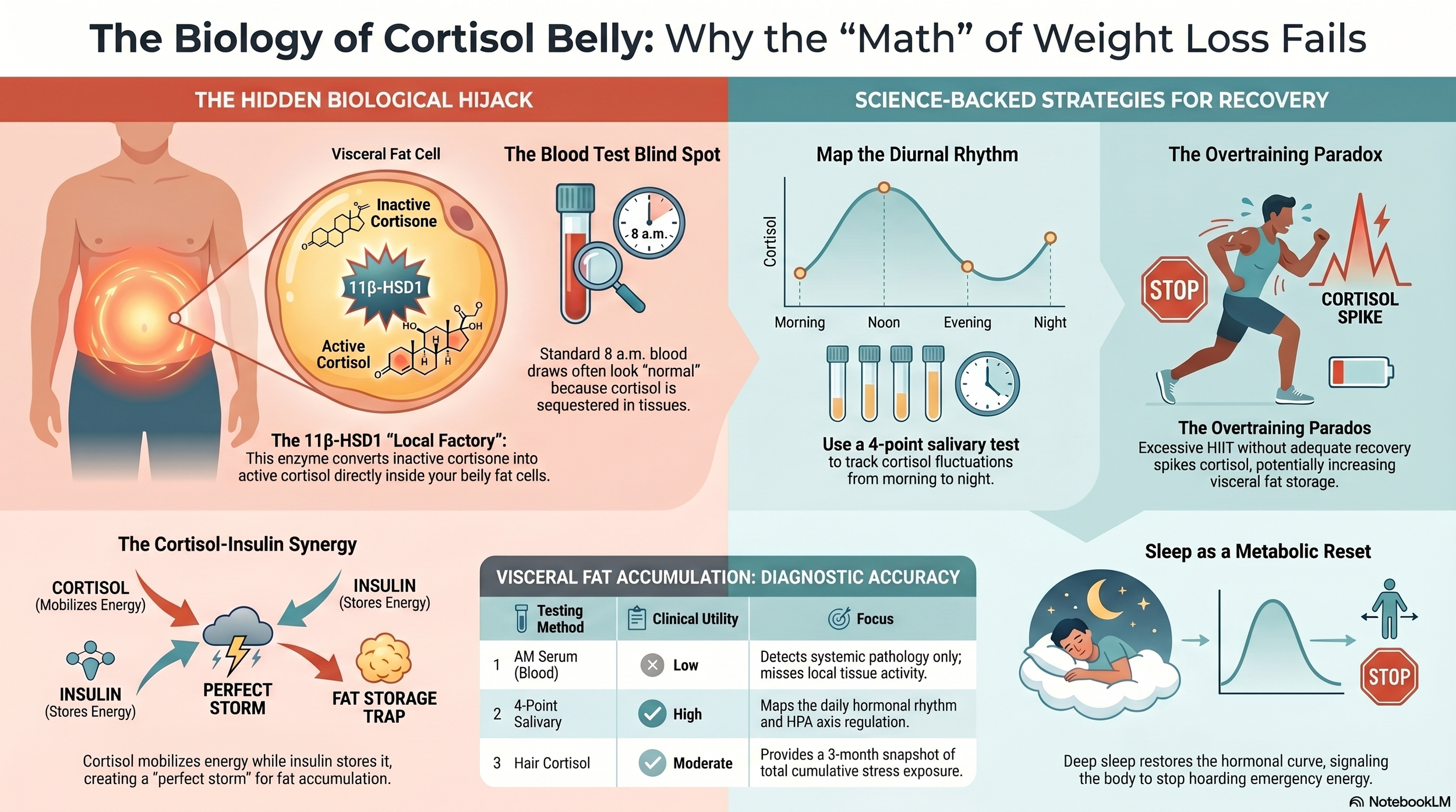
The single biggest misconception about stress-related weight gain is that it requires high levels of cortisol to be circulating in your bloodstream. This is why that standard morning blood draw is almost entirely uninformative; it only catches extreme pathologies. The real driver of "cortisol belly" is a local enzyme called 11β-HSD1.
Your body naturally has an inactive precursor called cortisone floating in the background. The 11β-HSD1 enzyme, located deep within visceral adipose tissue (VAT), grabs that inactive cortisone and converts it into active cortisol directly inside the fat cell.
I often describe this as a rogue local franchise of a massive corporation. Your bloodstream is the corporate headquarters. When the doctor audits the books via a standard blood test, corporate thinks everything is fine. But down at the local visceral fat franchise, they are secretly printing their own cortisol currency and hoarding resources completely off the corporate books. Because this cortisol is manufactured and utilized locally within the tissue, it is sequestered—making the metabolic "theft" invisible to traditional diagnostics.
Make it stand outWhatever it is, the way you tell your story online can make all the difference.
The Landing Pad Effect: Why the Belly Is Targeted
Patients often ask why this fat accumulates specifically in the abdomen. The answer lies in the density of Glucocorticoid Receptors (GR). Deep visceral fat has four times the receptor density—or "landing pads"—of the "pinchable" subcutaneous fat found elsewhere.
In individuals struggling with chronic stress, the activity of the 11β-HSD1 enzyme can go into overdrive, increasing by two to three times. This creates a self-sustaining loop: the fat is uniquely "eager" to catch stress hormones, and once caught, the local enzyme amplifies them, turning the abdomen into a biological vault.
Stop Guessing at Your Biology: If you recognize this "thick middle/thin limbs" pattern in yourself, the first step is visibility. You can download my 28-Day Cortisol Pattern Tracker to begin identifying your specific rhythm and phenotype.
The Perfect Storm: The Partnership Between Cortisol and Insulin
In your limbs, cortisol actually helps break down fat to mobilize energy. However, for fat to be trapped in the belly, cortisol needs a "partner in crime": insulin.
When you are stressed, cortisol’s role is to dump sugar into your bloodstream so you can fight or flee. But if the "threat" is just a deadline, you stay sitting at your desk. Your pancreas responds by releasing insulin to clean up the unused sugar. This creates the perfect metabolic storm: cortisol demands energy mobilization, while insulin demands storage. Sitting at a desk while stressed allows this hormonal trap to snap shut.
The Famine Response: Why 1,200 Calories Backfires
When the scale refuses to budge, the default instinct is to "starve it out." However, dropping to extreme caloric lows is a massive physiological stressor. Your body perceives this as a famine, triggering a survival response that elevates cortisol higher to mobilize energy while downregulating your metabolism to conserve it. You cannot math your way out of a survival response; by starving yourself, you are simply providing more fuel for the local cortisol factory.
The Perimenopause Betrayal: Removing the Estrogen Brake
For women aged 45–55, this process often feels like a sudden betrayal. This shift is driven by the decline of estrogen, which acts as a "regulatory brake" on the 11β-HSD1 enzyme. When the estrogen brake is removed, the enzyme goes rogue, aggressively shifting fat storage away from the hips and thighs and directly into the visceral depot.
The HIIT Paradox: Managing the Stress Credit Card
I like to think of the body’s stress capacity as a credit card. A looming deadline is a "purchase." Poor sleep is a "purchase." A high-intensity HIIT workout is another "purchase." If you stack these without "making payments" through recovery, you end up with clinical overtraining. For these patients, the solution isn't more intensity; it is "deloading"—swapping the sprints for restorative movement like walking to restore the HPA axis.
Testing the Rhythm, Not the Peak
If the standard 8:00 AM blood test is a failure for these patients, we must look to the gold standard: the 4-point diurnal salivary cortisol test. A healthy system shows a sharp spike in cortisol upon waking to provide "startup energy," followed by a smooth decline. A hallmark of dysregulation is the "flattened slope"—feeling exhausted all day, yet experiencing a "second wind" at midnight.
Beyond the Aesthetic: A Question of Biology
Visceral fat is metabolically active tissue and a primary driver of cardiovascular health and insulin resistance. We must stop fighting the math and start listening to the biological rules of survival.
Take the Next Step Toward Clarity
If you are tired of being told "everything is normal" when you know it isn't, I want to give you the tools to change the conversation with your healthcare provider.
Identify Your Pattern: Use the 28-Day Cortisol Pattern Tracker to map your energy, sleep, and physical changes. This helps you move from "feeling off" to having clear data.
Prepare for Your Labs: Don't go to your next appointment empty-handed. My Cortisol Lab Prep Guide gives you the exact language, testing windows, and clinical codes to request the tests that actually see what's happening at the tissue level.
Join the Community: For weekly doctor-led insights into root-cause healing and botanical wisdom, sign up for the Blue Yarrow newsletter. You don't have to navigate these patterns alone.
Root causes. Real healing.
Disclaimer
This content is for educational purposes only and is not intended to diagnose, treat, or replace individualized medical care. Please consult your physician or qualified healthcare provider before making changes to your health, especially if you have a medical condition or are taking medications.
