What the Evidence Actually Says About Rose
Conventional medicine files rose under “pleasant flavoring.” The wellness aisle files it under “calms anxiety, balances hormones, eases cramps.” Both are wrong, and the truth sits in the gap between them.
Here is the plain answer. Rose is two different medicines wearing one name. The one thing most women expect it to fix, period cramps, is the one thing the pooled trials say it does not do.
I am Dr. Shad Abdulla, ND, and I read the actual studies before I trust a label. What follows separates the petal from the fruit, names what each one can and cannot do, and hands you a save card you can keep.
So let me back up and start with the thing almost everyone gets wrong.
Why is rose treated as one herb when it is really two?
The first mistake is lumping it all together, and I understand why. The flower, the oil, the tea, the little capsules of orange-red powder all say “rose” on the front. But your body meets two separate plants.
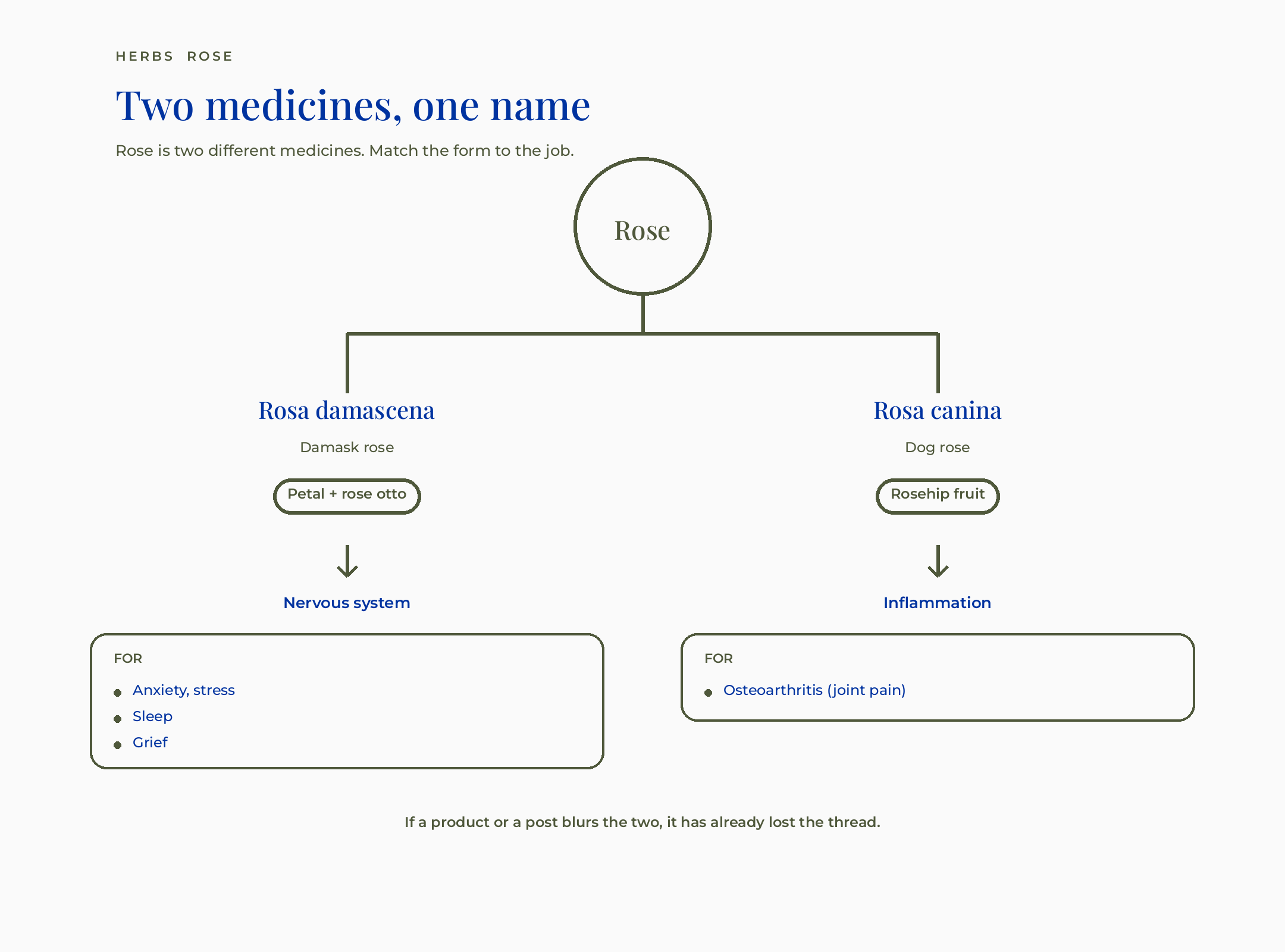
Rosa damascena is the Damask rose. That is the petal and the steam-distilled oil called rose otto. Meaning the fragrant part, the part traditional herbalists reach for when someone is grieving, wired, or cannot fall asleep. Its action is on the nervous system.
Rosa canina is the dog rose, and the medicine is the rosehip. Meaning the fruit, the little red pod left after the petals drop. Its action is anti-inflammatory, and the research on it points almost entirely at joints, not nerves.
The naturopathic lens on this matters. I was trained to honor the whole plant and to ask what part, in what form, for what tissue. Rose is the cleanest example I know of why “an herb” is the wrong unit. The form is the medicine.
Bottom line: petal and oil are for the nervous system, rosehip is for inflamed joints. If a product or a post blurs the two, it has already lost the thread.
Does rose actually calm anxiety and help you sleep?
Short answer: a little, and honestly. Inhaled Damask rose produced real short-term drops in anxiety and stress across the pooled trials. But the effect is soft, and the studies are easy to fool.
Here is what the research supports. A 2021 dose-response meta-analysis pooled 32 publications and found inhaled or oral Rosa damascena lowered state anxiety and stress. A separate 2021 review found bedtime rose aromatherapy improved short-term sleep quality. That is real. It is also rated very low to moderate certainty. In plain terms that means the true effect could be much smaller than the headline number, or close to nothing.
And there is a catch you cannot engineer away. Inhaled Damask rose lowered state anxiety across 32 trials, but no scent can be blinded (Rasooli 2021). You always know whether you are smelling roses or smelling paraffin. So part of what the studies measured is not the molecule, it is the simple pleasure and expectation of a beautiful scent. That is not nothing, but it is not a drug effect either.
There is a second flag worth saying out loud. Most of the positive trials come from one research culture, clustered in Iran and Turkey. So the whole conversation runs through a narrow set of methods. The mechanism work is early too. It points at serotonin signaling in animal studies, not the GABA pathway many wellness sources assume.
Picture the woman who keeps a little roller of rose oil in her bag for a hard afternoon. What this means for her: keep it. It can genuinely take the edge off a stressful evening. Just hold it as a gentle ritual, not a treatment for an anxiety disorder. It is also not a reason to skip the care a real anxiety problem needs.
Bottom line: rose aromatherapy can soften a stressful moment, partly because it smells wonderful. That is a fair use. It is not a prescription.
Can rose tea or rose oil ease period cramps?
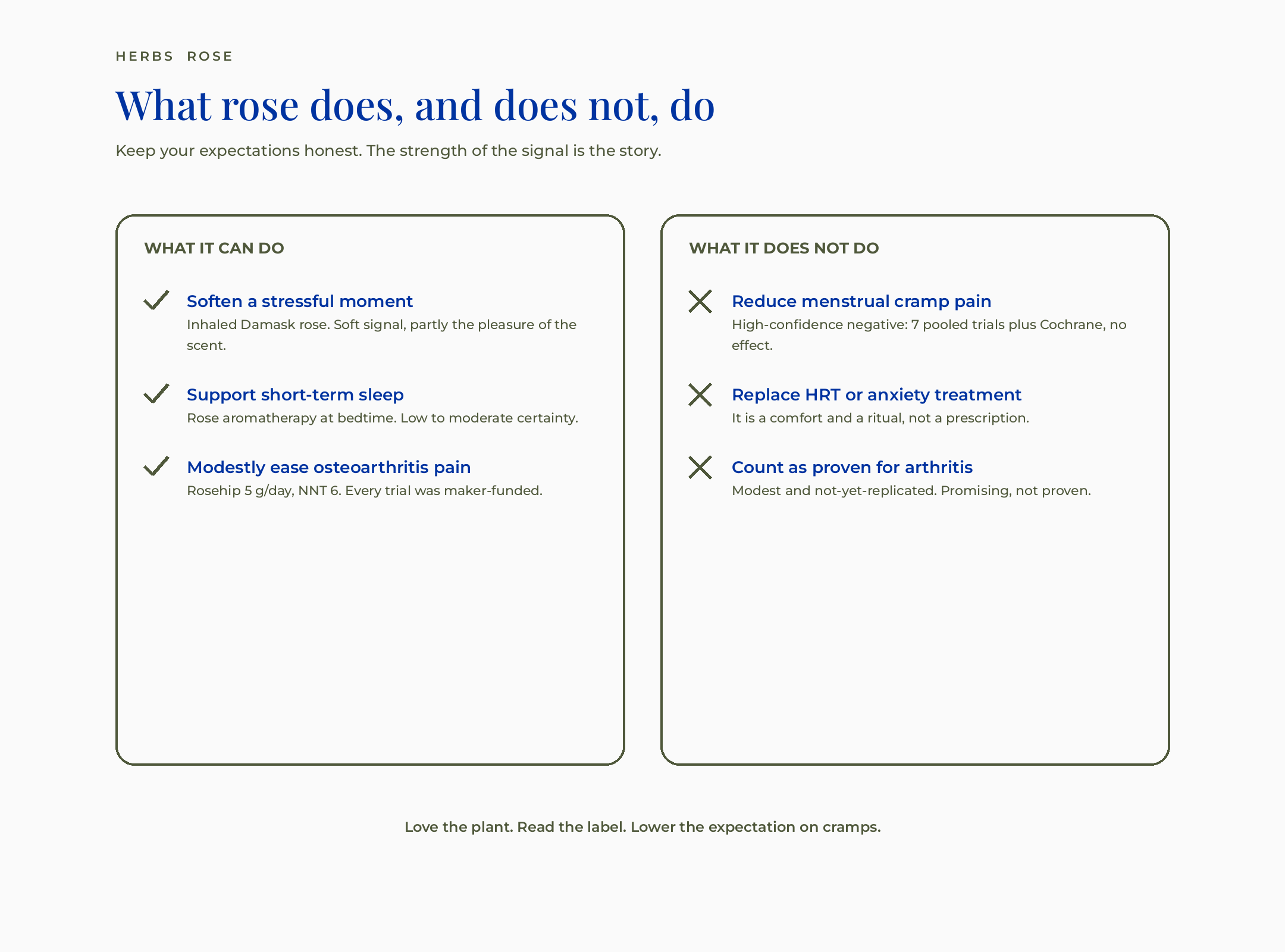
This is the one I most want you to hear, because it is the claim rose cannot keep. Rose does not reliably reduce menstrual cramp pain. The pooled trials are clear, even though rose has been the beloved women’s herb for centuries.
Here is the evidence, walked through plainly. A 2021 meta-analysis pooled 7 randomized trials in women aged 18 to 35 and found rose made no significant difference to menstrual cramp pain. The 2016 Cochrane review is the reference standard for this kind of question. It landed in the same place: Damask rose was no better than an anti-inflammatory drug, on low-certainty evidence. Across 7 pooled trials, rose did not reduce menstrual cramp pain, only headache and bloating (Koohpayeh 2021).
Now, the root-cause version of this question is more interesting than a yes or no. Why does this myth hold on so tightly? Because rose really does do adjacent things. The same pooled data showed it eased period-related headache, fatigue, and bloating. So a woman drinks rose tea, feels her headache lift and her bloat settle, feels calmer, and credits the cramps to rose too. The relief was real. The attribution was off.
A woman I worked with described exactly this. Her name is changed, of course. She had been drinking rose tea every luteal week for a year, convinced it was her cramp cure, frustrated that some months it “stopped working.” When I walked her through what the trials actually show, she realized the tea had been helping her wind down and bloat less. That was worth keeping. Her cramps, though, were tracking something else entirely. That reframe sent her toward an approach that actually targeted the pain.
What this means for the woman in front of me: if rose tea softens a rough premenstrual week, keep it for the comfort. Just do not let it stand in for something that treats the cramp itself. And do not blame yourself when it does not touch the pain. It was never going to.
Bottom line: rose is comfort and ritual for a hard week, not a cramp remedy. Expecting it to kill period pain sets you up to feel let down by a plant that was helping you in other ways.
Does rosehip really work for arthritis and joint pain?
Now to the other plant entirely. Rosehip, the fruit of Rosa canina, has the one oral-supplement story in the whole genus with a meta-analysis behind it. It is also a genuinely useful lesson in how to read a study, not just whether it is positive.
Here is what the research supports, and the asterisk that comes with it. A 2008 meta-analysis pooled three trials of standardized rosehip powder, about 5 grams a day, in osteoarthritis. Meaning the wear-and-tear joint disease, not the autoimmune kind. It found a modest pain reduction, with a number-needed-to-treat of 6. Meaning that for every six people who took it, roughly one got meaningful relief. The trials were also consistent with each other, which is a real plus.
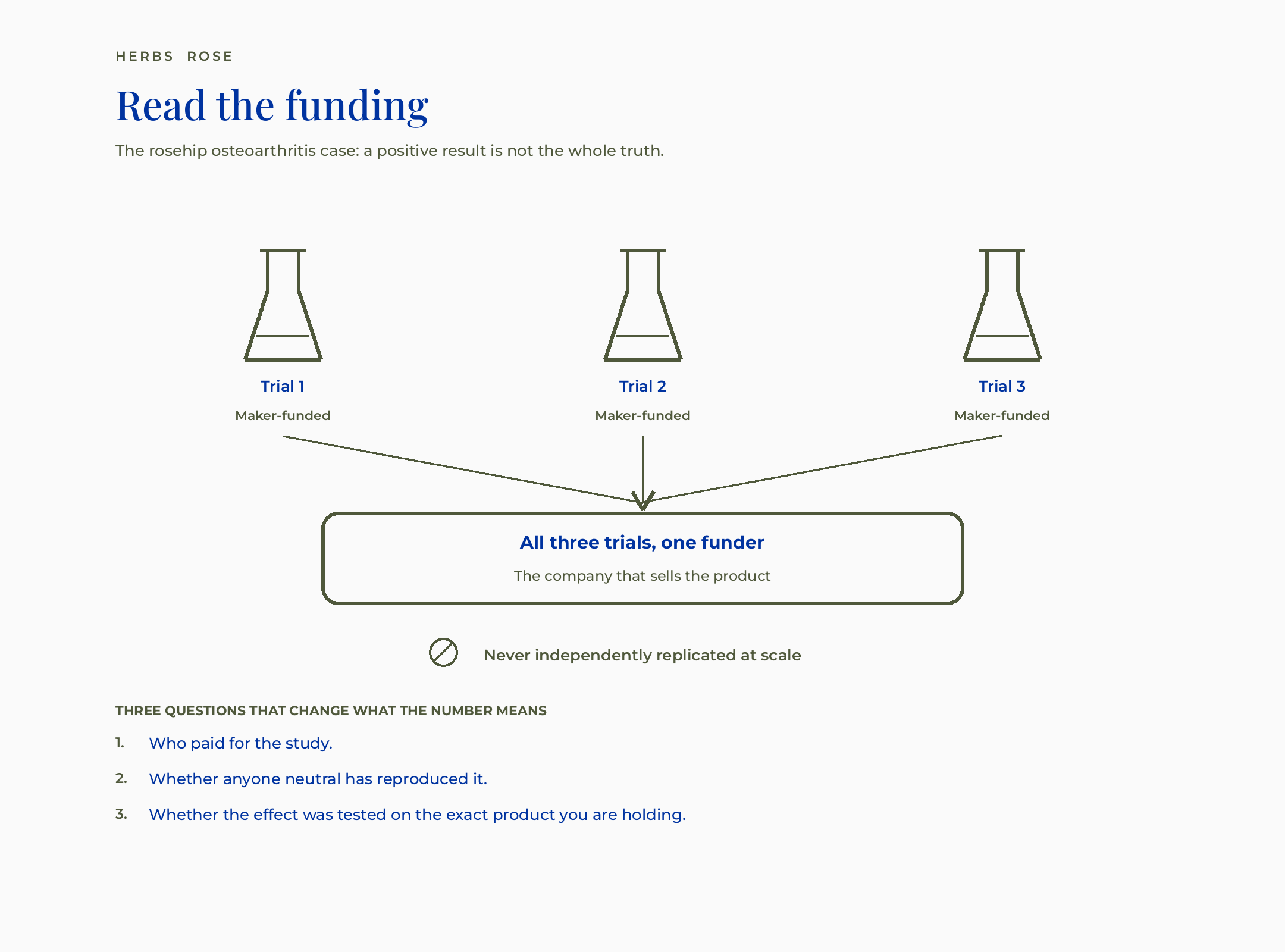
And here is the part the supplement ads leave out. Rosehip’s only osteoarthritis meta-analysis shows NNT 6, but all three trials were maker-funded (Christensen 2008). Every supporting trial was paid for by the company that sells the product. No independent team has replicated the finding at scale in the years since. The authors themselves asked for that independent replication. It has not happened.
A woman I worked with, her details changed for confidentiality, had bought a generic rosehip powder off a marketplace listing that quoted the arthritis study. She felt let down when three months did nothing. The study she was sold had used a specific standardized product, not the bag in her cupboard. The fine print was the whole story.
This is the teaching moment. It is the naturopathic root-cause habit I most want to pass on: a positive result is not the whole truth. Three questions change what the number means. Who paid for the study. Whether anyone neutral has reproduced it. Whether the effect was tested on the exact product you are holding. The osteoarthritis data apply to specific standardized branded products, not to a generic bag of rosehip powder.
What this means for the woman in front of me with achy knees: rosehip is a low-risk, modest, not-yet-proven option, eyes open about the funding. Give it a fair few months as a test. It is not the proven natural arthritis cure the marketing implies. I walked through this same read-the-funding pattern for another adored supplement in Creatine for Women: What It Does, and What It Doesn’t.
Bottom line: standardized rosehip might modestly ease joint pain, but the only evidence comes from the maker, unreplicated. Try it if you like, with honest expectations and a standardized product.
Is rose safe just because it is natural?
Let me re-orient you here, because this is where the “it is just a flower” reflex gets people. Rose is one of the gentlest botanicals there is. Gentle is not the same as consequence-free, and the cautions are real even if they are quiet.
Here is what conventional safety reviews and the herbal monographs actually say. Rosehip carries a real load of vitamin C, enough to matter for a few specific people. If you take warfarin or another blood thinner, that vitamin C can nudge how the drug works. That makes it a talk-to-your-prescriber situation, not a grab-it-off-the-shelf one. If you are on hormonal birth control or hormone therapy, vitamin C can raise estrogen levels modestly. If you form kidney stones, high-dose vitamin C raises that risk, mostly studied in men. And rosehip can change how you absorb iron and some antibiotics, so separate them by 2 to 4 hours.
Pregnancy deserves a flat answer, not a hedge. Rose is not established as safe in pregnancy or breastfeeding, and the European Medicines Agency specifically advises against rose flower products during pregnancy and lactation. Meaning the honest position is “not enough data, so do not assume,” not “natural, so fine.”
Two more practical notes. There is no long-term safety record beyond about four months for either form, because the studies simply did not run longer. And rose essential oil is one of the most commonly adulterated oils on the market, often cut with synthetic fragrance chemicals. That both waters down any benefit and raises the odds of a skin reaction. Buy from someone who tests, and never take essential oil internally.
What this means for the woman on a daily birth control pill or a blood thinner: rose is probably fine for you. The word “probably” is doing real work there. A two-minute conversation with your pharmacist settles it. That is the whole ask.
Bottom line: rose is low-risk, not no-risk. The vitamin C in rosehip is the part that interacts, pregnancy is a clear “not established,” and “natural” was never a safety guarantee.
What I’d do this week
If you love rose, and I do too, here is how to keep loving it without being fooled by it. Match the form to the job, and keep your expectations honest. This is the part worth saving.
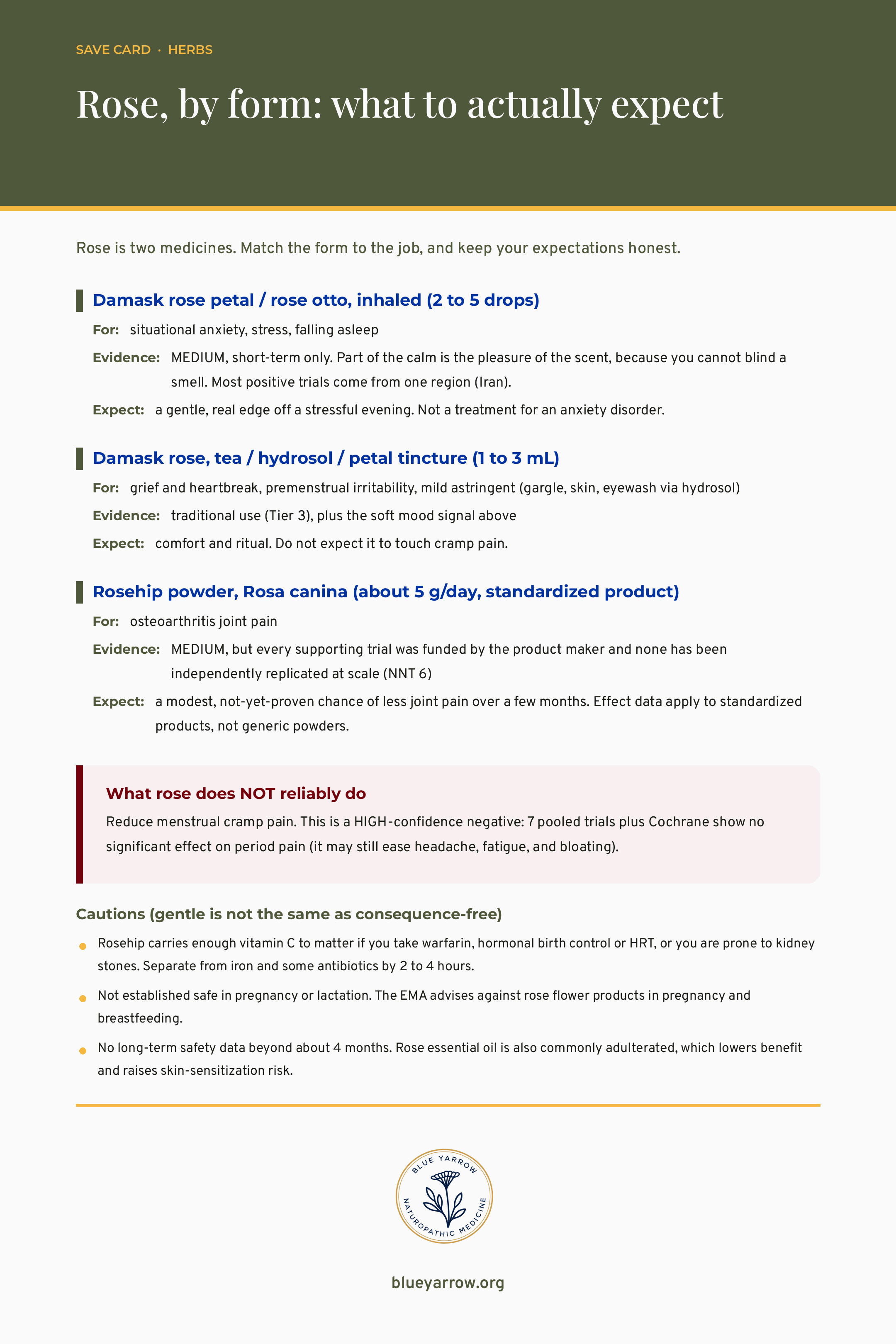
So this week, if rose is already in your life, keep the part that comforts you and drop the expectation it cannot meet. If you are reaching for it on joint pain, choose a standardized rosehip product and give it a fair few months. And if you take a blood thinner or daily hormones, send your pharmacist one text before you start.
Where rose sits in the bigger picture of women’s herbs
Let me widen the frame for a moment, because rose is not the only beloved women’s herb that turns out to be lightly proven. The pattern repeats across the wellness aisle. A plant earns deep cultural trust, the marketing inflates it past the evidence, and the honest answer lives in between.
I walked through the same kind of audit for another adored women’s botanical in Black Cohosh: What the Evidence Actually Supports. Same shape, different plant: cherished, marketed hard, and far softer in the trials than the bottle suggests. Reading the two together is the best way to build the instinct that protects you in any supplement aisle.
What I want you to walk away with is the instinct, not just the rose facts. Ask what part of the plant. Ask what the trials actually measured. Ask who paid for them. That is the difference between being moved by a beautiful remedy and being fooled by one. You can hold both reverence and skepticism at the same time.
Bottom line: rose is the case study, not the exception. Love the plant, read the label, lower the expectation on cramps, and carry that same three-question habit into every herb you meet.
Frequently asked questions
Does rose tea help with period cramps? Not reliably. Across 7 pooled randomized trials and a 2016 Cochrane review, Damask rose showed no significant effect on menstrual cramp pain. It may ease related headache, fatigue, and bloating, which is likely why the cramp myth persists. The pain itself does not consistently respond to rose.
What is the difference between rose oil and rosehip? They are two different medicines. Rose oil and petals come from Rosa damascena and act on the nervous system for stress and sleep. Rosehip is the fruit of Rosa canina and acts as an anti-inflammatory, studied mainly for osteoarthritis joint pain. Matching the form to the job is the whole skill.
Is rosehip good for arthritis? Possibly, modestly. One meta-analysis of standardized rosehip powder at about 5 grams a day found a small osteoarthritis pain benefit, with a number-needed-to-treat of 6. The catch is that every supporting trial was funded by the product maker and none has been independently replicated. Treat it as promising, not proven.
Is rose safe during pregnancy? It is not established as safe. The European Medicines Agency advises against rose flower products in pregnancy and breastfeeding. There are no reproductive safety studies, and no long-term data exists beyond about four months. The honest position is to avoid it in pregnancy rather than assume it is fine because it is natural.
Does rose aromatherapy actually reduce anxiety? A little, on soft evidence. Pooled trials show inhaled Damask rose lowers short-term anxiety and stress. But the certainty is low, the trials cluster in one region, and you cannot blind anyone to the smell of roses. So part of the effect is the simple pleasure of the scent. It is a fair comfort, not a treatment for an anxiety disorder.
Can rose otto be taken internally? No. Rose essential oil, including rose otto, is for inhalation or properly diluted topical use only, never swallowed. It is also one of the most commonly adulterated oils, so buy from a supplier that tests for purity. The gentlest internal forms are rose petal tea, tincture, or hydrosol.
This content is for educational purposes only and is not medical advice. Please consult with your healthcare provider for individual recommendations.
References
1. Rasooli, R., Nasiri, M., et al. (2021). The effect of Rosa damascena on anxiety, depression, and stress: A systematic review and dose-response meta-analysis. Phytotherapy Research, 35(12), 6585-6597. https://doi.org/10.1002/ptr.7243
2. Ghorbani Rami, F., Nasiri, M., et al. (2021). The effect of Rosa damascena on improvement of adults’ sleep quality: A systematic review and meta-analysis of randomized controlled trials. Sleep Medicine, 87, 8-19. https://doi.org/10.1016/j.sleep.2021.07.017
3. Koohpayeh, S. A., Hosseini, M., Nasiri, M., & Rezaei, M. (2021). Effects of Rosa damascena (Damask rose) on menstruation-related pain, headache, fatigue, anxiety, and bloating: A systematic review and meta-analysis of randomized controlled trials. Journal of Education and Health Promotion, 10, 272. https://doi.org/10.4103/jehp.jehp_18_21
4. Pattanittum, P., Kunyanone, N., Brown, J., et al. (2016). Dietary supplements for dysmenorrhoea. Cochrane Database of Systematic Reviews, 3, CD002124. https://doi.org/10.1002/14651858.CD002124.pub2
5. Christensen, R., Bartels, E. M., Altman, R. D., Astrup, A., & Bliddal, H. (2008). Does the hip powder of Rosa canina (rosehip) reduce pain in osteoarthritis patients? A meta-analysis of randomized controlled trials. Osteoarthritis and Cartilage, 16(9), 965-972. https://doi.org/10.1016/j.joca.2008.03.001
6. Gruenwald, J., Uebelhack, R., & More, M. I. (2019). Rosa canina, rose hip pharmacological ingredients and molecular mechanics counteracting osteoarthritis: A systematic review. Phytomedicine, 60, 152958. https://doi.org/10.1016/j.phymed.2019.152958
7. Ferraro, P. M., Curhan, G. C., Gambaro, G., & Taylor, E. N. (2015). Total, dietary, and supplemental vitamin C intake and risk of incident kidney stones. American Journal of Kidney Diseases, 67(3), 400-407. https://doi.org/10.1053/j.ajkd.2015.09.005
8. Xia, N., Wang, J., Guo, Q., et al. (2024). Deciphering the antidepressant effects of Rosa damascena essential oil mediated through the serotonergic synapse signaling pathway. Journal of Ethnopharmacology, 326, 118007. https://doi.org/10.1016/j.jep.2024.118007
9. European Medicines Agency, Committee on Herbal Medicinal Products. (2014). Community herbal monograph on Rosa gallica L., Rosa centifolia L., Rosa damascena Mill., flos (EMA/HMPC/137299/2013). European Medicines Agency.
