Senolytics: Real Science, Premature Product
If you have a bottle of fisetin in your cart, or you already bought it because a longevity podcast called it a “zombie cell killer,” I want to slow you down before you spend more. You are not being naive. The science underneath this is real, and senescence (the state where a cell stops dividing but refuses to die and keeps leaking inflammatory signals) is one of the best-validated mechanisms of aging in the literature. The problem is the gap between that mechanism and the product on the shelf, and almost no one selling you the capsule will name it. Here is what I want you to know up front. Senolytics are real science and a premature consumer product at the same time, and both are true at once. The impressive human pilot results came from a chemotherapy drug protocol, not the flavonoid capsule. No efficacy trial has tested these compounds for benefit in healthy women in their 30s and early 40s. And the one study that looked at reproductive-age females found no fertility benefit at all. In this piece I will walk you through what senescence actually is, what the trials really tested, where the science is genuinely working, the reproductive-age question nobody is asking, the interactions that matter, and a decision tree you can screenshot. By the end you will know what you are buying and whether it belongs on your list yet.
What are senolytics and senescent cells, in plain language?
Senolytics are compounds designed to selectively kill senescent cells, the aged cells that stop dividing but stay alive and leak inflammatory signals into the tissue around them. That mechanism is real, and it is the part of this story the supplement aisle gets right.
Let me back up a little, because the words matter here. A senescent cell is a cell that has hit a stop sign. It will not divide anymore, but instead of clearing out, it lingers and secretes a mix of inflammatory molecules called the SASP (the senescence-associated secretory phenotype, basically the chemical exhaust an old stalled cell pumps into its neighborhood). Over decades these cells accumulate, and the SASP contributes to the low-grade inflammation that climbs with age. The marker researchers most often use to count these cells is p16 (a protein, p16INK4a, that rises as cells enter senescence). This part is textbook, and the strongest reviews in the most authoritative journals agree on it.
What this means for the woman reading this is simple. The biology you heard about on that podcast is not made up. Senescent cells are real, they accumulate, and clearing them is a legitimate scientific target. The trouble starts at the next step, where mechanism gets sold to you as a finished product.
The micro-summary so far: senescent cells are real, they accumulate with age, and they drive inflammation through the SASP. The mechanism is solid. That is not the same as proof the capsule works.
Do senolytics actually work in humans, or is it mouse data?
The honest answer is that the human evidence is real but tiny, and the most impressive results came from a prescription drug protocol, not the supplement on the shelf. The famous lifespan-extension data that gets quoted everywhere is from mice, not people.
Here is the felt experience first, because I know why you are asking. You have been burned before. You bought the NMN, you bought the resveratrol, and you are tired of falling for the next mechanism. So you want a straight yes or no. The straight answer is that the first human demonstration that these compounds reduce senescent-cell burden came from a 2019 pilot of dasatinib plus quercetin (D+Q, where dasatinib is a leukemia chemotherapy drug and quercetin is a flavonoid) in nine people with diabetic kidney disease, average age around 69 (Hickson 2019). It worked at the level of the marker. It reduced senescent cells in fat and skin. But it was nine elderly, sick people, no control group, and it measured a marker, not whether anyone lived better or longer.
This is the line worth keeping: Every human senolytic pilot used dasatinib, a chemo drug, plus quercetin, not the fisetin capsule (Hickson 2019, n=9). The lifespan story you have actually heard, the one about fisetin extending life, comes from a 2018 mouse study. Mouse lifespan data is genuinely exciting and it is also not human proof.
What this means for the woman in front of me is that “it works in humans” and “the supplement I bought works in humans” are two different claims, and only the first one has even thin support.
Why does the drug-versus-supplement distinction matter so much?
It matters because the product that produced the human results is not the product you can buy. The trials used dasatinib, a prescription chemotherapy drug, combined with quercetin. The capsule on the shelf is fisetin or quercetin alone, with no dasatinib in it.
If you have ever read a study headline and assumed the bottle in your hand is the thing they tested, that is the trap, and the marketing is built on it. Both the drug protocol and the capsule get called “senolytics,” so the distinction is invisible to almost everyone. But it is the whole game. Dasatinib is doing a lot of the heavy lifting in those pilots. It is also a serious drug with real risks, which is exactly why it lives behind a prescription and an oncologist. The flavonoid capsule is a different intervention with a different, much thinner evidence base, and it is not yet known whether fisetin or quercetin alone reaches the threshold in a human body that the drug combination did.
There is also a dose-and-absorption problem layered underneath. Fisetin and quercetin both have poor oral bioavailability, which means the amount that actually gets into your bloodstream from a capsule is far less than the dose used in the mouse studies people quote. The pharmacokinetic trials that would establish what commercial fisetin actually reaches in a human body are only being run right now.
The micro-summary: the human pilot data come from a chemo drug plus a flavonoid. The capsule on the shelf is the flavonoid alone, at doses that may not even reach the body the way the mouse studies assumed. The supplement is not the trial.
What this means for the woman in front of me is that “the supplement is the same thing they used in the trials” is the single most common misconception I see attached to this topic, and it is not true.
How many senolytic trials actually exist, and who was in them?
Very few, and almost none of them studied anyone like you. The entire field rests on a handful of small trials, mostly in elderly or sick people, plus one larger study in postmenopausal women that did not meet its main goal.
I want to give you the number plainly, because the number is the whole story: Only nine senolytic trials exist, just two are controlled, and zero enrolled healthy women 30 to 45 (ClinicalTrials.gov, 2026). That is not me being a skeptic for sport. That is the registry. The published human trials enrolled people with diabetic kidney disease, idiopathic pulmonary fibrosis (a progressive scarring lung disease), early Alzheimer’s, and postmenopausal women being studied for bone. The average ages run from the high 60s to the high 70s. The fisetin and D+Q trials still recruiting are in frail elderly, cancer survivors, people with COPD, and similar populations.
For the woman who is 38, sleeps reasonably well, lifts a couple of times a week, and is wondering if fisetin is the next smart move, here is the uncomfortable truth. You are not the population anyone has studied. That does not mean the compound is dangerous for you. It means the science genuinely does not know what it does in your body, because the question has not been asked in a trial.
What this means for the woman in front of me is that when a creator says “the research supports senolytics for longevity,” the research they are pointing at was done in people two or three decades older than you, often with a serious disease, and even then it mostly measured markers rather than outcomes.
Where do senolytics actually have a real human signal?
There is one place the human science is genuinely working, and it deserves real credit: bone, in postmenopausal women who carried the highest burden of senescent cells. This is the most encouraging finding in the whole field, and I do not want to bury it.
If you are in your early 40s and bone is starting to be on your radar, this is the part that should make you pay attention rather than tune out. In a 2024 phase 2 randomized trial of intermittent D+Q in 60 postmenopausal women, the overall result was a miss. The primary endpoint, a marker of bone breakdown called CTx (C-terminal telopeptide, a blood marker of how fast bone is being resorbed) at 20 weeks, did not differ between the treated group and the control group. That is an honest negative, and the supplement world tends to leave it out of the retelling. But inside that trial, the women who started with the highest senescent-cell burden showed a real, statistically significant increase in bone density at the radius (Farr 2024). Another marker of bone formation, P1NP (procollagen type 1 N-terminal propeptide, a blood signal of new bone being built), rose early before settling back.
That subgroup result is biologically coherent. If a senolytic works by clearing senescent cells, you would expect the biggest benefit in the people who had the most cells to clear, and that is exactly the pattern they saw. The National Institute on Aging, which is about as conservative and credible a voice as exists here, looked at the whole picture and called the overall effect “subtle.” I think both things are true. This is the most promising human signal in the field, and it is still an exploratory subgroup in a trial that missed its primary endpoint.
The micro-summary: the strongest human signal is bone density in postmenopausal women with the highest senescent-cell burden. It is genuinely promising, it is exploratory, and the primary endpoint was missed. Both are true.
What this means for the woman in front of me, especially if she is perimenopause-adjacent and thinking about bone, is that this is the lane to watch, not the lane to buy into yet. Watching a promising signal mature is different from acting on it before it has matured.
What about fisetin for ovarian aging and fertility?
This is the claim I most want to address directly, because it targets exactly the women reading this, and the evidence runs against it. The only study that looked at senolytics in reproductive-age females found no improvement in fertility or ovarian reserve.
I need to be careful and precise here, because this is animal data and I will not turn it into a scare. In two experiments in reproductive-age female mice, neither fisetin nor D+Q improved pregnancy rate, litter size, or ovarian reserve (Garcia 2024). Some markers of ovarian senescence did go down, which is interesting, but the outcomes that actually matter, the ability to conceive and the size of the egg supply, did not improve. The line worth holding: Across two experiments in reproductive-age female mice, fisetin and D+Q improved neither fertility nor ovarian reserve (Garcia 2024).
Here is what I want you to take from that, and what I do not. I am not telling you fisetin harms your ovaries. That is not what the study showed. What it showed is a clean null, no benefit, plus a set of unresolved effects that cannot yet be interpreted. So when a supplement is marketed to you specifically for ovarian aging or fertility, the honest read is that the one piece of relevant evidence on the table does not support that claim, and there is no human pregnancy or fertility safety data at all.
This is the part that frustrates me as a doctor who writes for women. Ovarian aging is an emotionally powerful search. It is the kind of fear sellers fill in precisely because conventional medicine often goes quiet on it. The vacuum gets filled with a claim the evidence contradicts, and you are the one who pays $60 to test a hypothesis on yourself that mice already failed.
The micro-summary: fisetin marketed for ovarian aging or fertility runs against the only reproductive-age data that exists, which showed no benefit. This is animal evidence and an honesty anchor, not a harm scare. There is no human fertility or pregnancy safety data.
What this means for the woman in front of me, the one who bought a bottle for her ovaries, is that I would gently tell her to save the money, because the marketing made a promise the science has not kept.
Are senolytic supplements safe to take?
Short-term, in supervised trials, the tolerability looked acceptable, with no serious adverse events tied to the protocol. But there is essentially no long-term human safety data, no pregnancy data, and the flavonoid compounds carry real drug interactions that matter for ordinary outpatients.
If you have ever been told “it’s natural, so it’s safe,” I want to retire that idea with you, because it is doing real harm in this category. Natural and safe are not the same word. Fisetin and quercetin both inhibit CYP3A4 (a major liver enzyme that processes a large share of prescription drugs) and P-glycoprotein (a transporter that pumps drugs in and out of cells). When you slow those systems down, you can change the blood levels of medications you are already taking. The named interactions of concern are blood thinners like warfarin, where bleeding risk can rise; immunosuppressants like cyclosporine, where levels become unpredictable; and active chemotherapy, which needs oncology oversight. None of that is fear-mongering. It is the same pharmacology that makes grapefruit a problem with certain drugs.
A few honest specifics. In the supervised trials, no serious adverse events were attributed to D+Q, which is reassuring as far as it goes. In the lung-disease pilot, sleep disturbance and anxiety showed up more in the treated group than the placebo group, a small signal worth noting. And dasatinib, the drug half of the famous protocol, carries its own serious risk profile because it is a chemotherapy agent, one more reason the drug and the capsule should never be spoken of as the same thing.
The micro-summary: short-term supervised use looked tolerable, but there is no long-term human safety data, no pregnancy data, and real interactions with blood thinners, immunosuppressants, and chemotherapy through CYP3A4 and P-glycoprotein. If you take any of those, talk to your prescriber first.
What this means for the woman in front of me is that the safest version of curiosity here is the one that checks her medication list before anything goes in the cart.
Where do senolytics actually belong on a longevity list?
Far down it, if they belong on it at all yet for a healthy woman. The levers with the strongest evidence for how you age are not in a capsule. They are sleep, protein and strength training, alcohol and stress management, and they sit above senolytics, not below them.
I know that is not the exciting answer. The exciting answer is the new molecule. But I have seen the same pattern over and over in cases I’ve reviewed and in patients I’ve worked with: the woman asking me about the frontier supplement is almost always the one already doing the boring, proven things well, and the woman who would actually benefit most from longevity attention has not slept seven hours in a year. The capsule is downstream of the things that move the needle. A healthy 38-year-old’s longevity return comes from muscle she builds and keeps, sleep she protects, and inflammation she lowers through how she lives, and none of that comes in a bottle labeled senolytic.
This is the third position I want you to hold. Not anti-senolytic, because the science is real and worth watching. Not a hype amplifier, because the product is premature for you. The science deserves your attention, the supplement does not yet deserve your money, and the foundational levers deserve both.
The micro-summary: for a healthy woman 30 to 45, senolytics sit far below sleep, protein, strength training, and stress management on the longevity list, if they belong on it yet at all. The proven levers are not in a capsule.
What I’d do this week
Here is the save card from this piece. Screenshot it, sit with it, and use it as the starting point for a real conversation with your provider before you spend anything. None of this is medical advice for your specific situation. It is the synthesis of what the evidence supports as of May 2026.
SENOLYTICS DECISION TREE
Where they belong on your list, and where they don't yet.
(Educational framework. Not a prescription.)
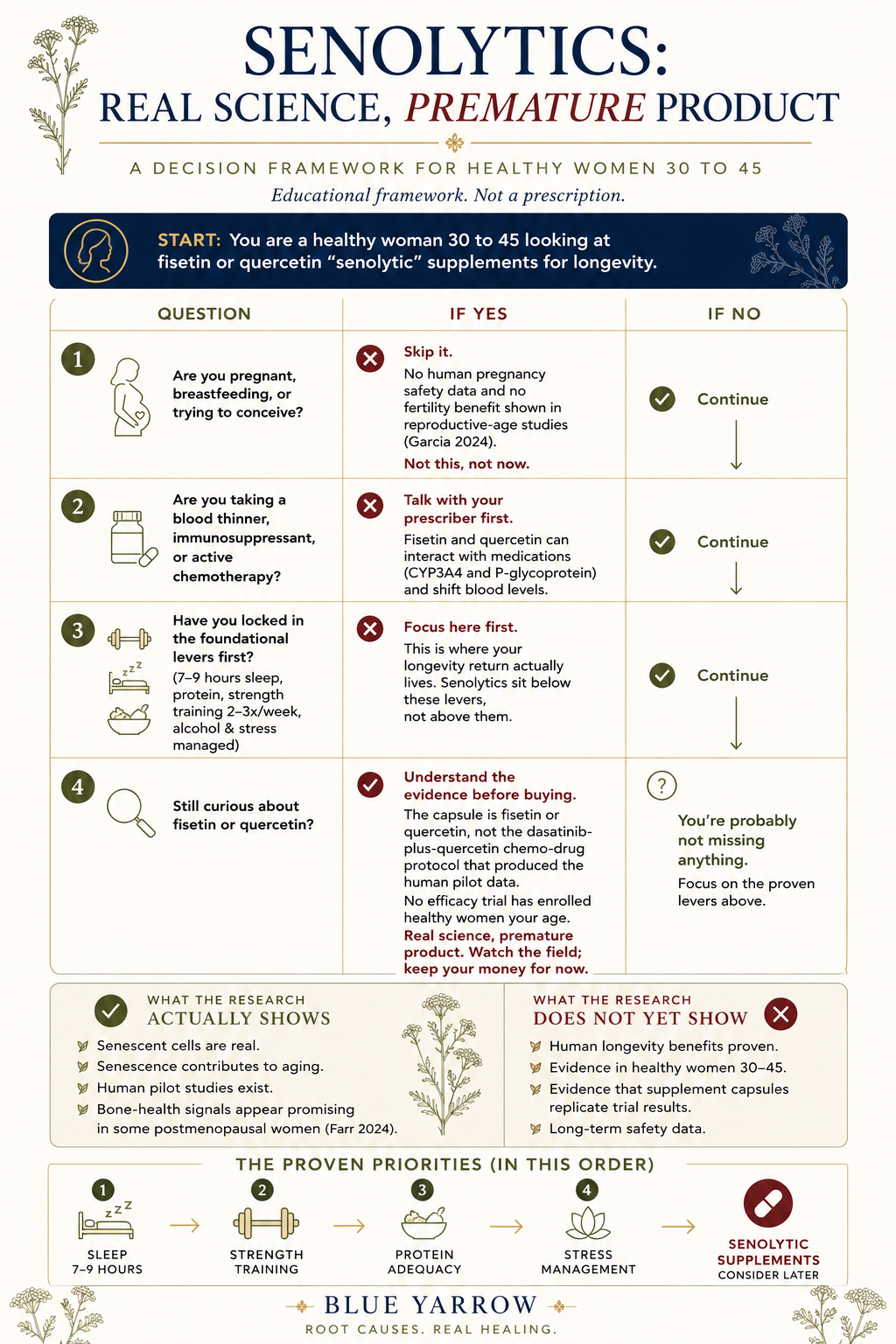
CAVEAT: Senescence biology is real and worth watching. The one place the human science is genuinely working is bone, in postmenopausal women who carried the highest senescent-cell burden (Farr 2024), and even there, the NIA called the overall effect "subtle." This card educates; it does not replace your provider.
The three moves for this week. First, if you already bought a bottle, do not throw it out in a panic and do not take it on autopilot either. Set it down and check it against the tree above. Second, write the exact reason you wanted it, ovaries, energy, longevity in general, and notice whether the evidence in this piece actually backs that reason. Third, if you take any blood thinner, immunosuppressant, or chemotherapy, that is a prescriber conversation before anything else.
A note on what I do and do not recommend
I built Blue Yarrow because I want to share my naturopathic doctor training and knowledge so that people who aren’t getting answers from conventional doctors can find the answers with me. That is a teaching mission, not a prescribing one. Nothing in this piece is a personalized recommendation, and I am not telling you to take or avoid anything. What I share with people who ask me about senolytics is exactly what is on this page: the science is real and worth watching, the supplement is premature for a healthy woman in her 30s or early 40s, and the decision belongs to you and the provider who knows your history.
Frequently asked questions
Do senolytic supplements like fisetin reverse aging in humans? No human study shows aging reversal. The dramatic lifespan data come from mice, and the human pilots measured a marker, senescent-cell burden, not whether people lived longer or better. Reducing a marker is not the same as reversing aging. The science is promising and early, not proven.
Is the fisetin capsule the same as what was used in the trials? No. The human pilot trials used dasatinib, a prescription chemotherapy drug, combined with quercetin. The capsule on the shelf is fisetin or quercetin alone, with no dasatinib. The supplement and the studied protocol are two different interventions with two different evidence bases.
Does fisetin help ovarian aging or fertility? The only reproductive-age study, in female mice, found no improvement in fertility or ovarian reserve from fisetin or the drug protocol (Garcia 2024). Some senescence markers fell, but the outcomes that matter did not improve, and there is no human fertility or pregnancy safety data. The marketing claim runs ahead of the evidence.
Are senolytic supplements safe to take long term? There is no long-term human safety data. Short-term supervised use looked tolerable, but fisetin and quercetin interact with blood thinners, immunosuppressants, and chemotherapy through liver enzymes and drug transporters. If you take any of those medications, talk to your prescriber before starting.
Is there any condition where senolytics actually show a human benefit? The most encouraging human signal is bone density in postmenopausal women who carried the highest senescent-cell burden (Farr 2024). It is real and worth watching, but it came from an exploratory subgroup in a trial that missed its primary endpoint, and the NIA called the overall effect subtle.
Should a healthy woman in her 30s take senolytics for longevity? Not yet, based on current evidence. No efficacy trial has enrolled healthy women 30 to 45, so what these compounds do in that body is genuinely unknown. The proven longevity levers for this age are sleep, protein, strength training, and stress management, and they sit far above senolytics.
This content is for educational purposes only and is not medical advice. Please consult with your healthcare provider for individual recommendations.
What did this piece change for you, and what were you hoping the bottle would do that you are now rethinking?
References
Hickson, L. J., Langhi Prata, L. G. P., Bobart, S. A., Evans, T. K., Giorgadze, N., Hashmi, S. K., … Kirkland, J. L. (2019). Senolytics decrease senescent cells in humans: Preliminary report from a clinical trial of dasatinib plus quercetin in individuals with diabetic kidney disease. EBioMedicine, 47, 446-456. https://doi.org/10.1016/j.ebiom.2019.08.069
Farr, J. N., Atkinson, E. J., Achenbach, S. J., Volkman, T. L., Tweed, A. J., Vos, S. J., … Khosla, S. (2024). Effects of intermittent senolytic therapy on bone metabolism in postmenopausal women: A phase 2 randomized controlled trial. Nature Medicine, 30(9), 2605-2612. https://doi.org/10.1038/s41591-024-03096-2
Farr, J. N., Monroe, D. G., Atkinson, E. J., Froemming, M. N., Ruan, M., LeBrasseur, N. K., & Khosla, S. (2025). Characterization of human senescent cell biomarkers for clinical trials. Aging Cell, 24(5), e14489. https://doi.org/10.1111/acel.14489
Garcia, D. N., Hense, J. D., Zanini, B. M., Isola, J. V. V., Prosczek, J. B., Ashiqueali, S., … Schneider, A. (2024). Senolytic treatment fails to improve ovarian reserve or fertility in female mice. GeroScience, 46(3), 3445-3455. https://doi.org/10.1007/s11357-024-01089-0
Nambiar, A., Kellogg, D., Justice, J., Goros, M., Gelfond, J., Pascual, R., … Kirkland, J. L. (2023). Senolytics dasatinib and quercetin in idiopathic pulmonary fibrosis: Results of a phase I, single-blind, single-center, randomized, placebo-controlled pilot trial on feasibility and tolerability. EBioMedicine, 90, 104481. https://doi.org/10.1016/j.ebiom.2023.104481
Gonzales, M. M., Garbarino, V. R., Kautz, T. F., Palavicini, J. P., Lopez-Cruzan, M., Dehkordi, S. K., … Orr, M. E. (2023). Senolytic therapy in mild Alzheimer’s disease: A phase 1 feasibility trial. Nature Medicine, 29(10), 2481-2488. https://doi.org/10.1038/s41591-023-02543-w
Lucas, V., Cavadas, C., & Aveleira, C. A. (2023). Cellular senescence: From mechanisms to current biomarkers and senotherapies. Pharmacological Reviews, 75(4), 675-713. https://doi.org/10.1124/pharmrev.122.000622
Riessland, M., Ximerakis, M., Jarjour, A. A., Zhang, B., & Orr, M. E. (2024). Therapeutic targeting of senescent cells in the CNS. Nature Reviews Drug Discovery, 23(11), 817-837. https://doi.org/10.1038/s41573-024-01033-z
Thau, H., Gerjol, B. P., Hahn, K., von Gudenberg, R. W., Knoedler, L., Stallcup, K., … Iske, J. (2025). Senescence as a molecular target in skin aging and disease. Ageing Research Reviews, 105, 102686. https://doi.org/10.1016/j.arr.2025.102686
Niedernhofer, L. J., Kirkland, J. L., et al. (2021). National Institute on Aging workshop: Repurposing drugs or dietary supplements for their senolytic or senomorphic effects: Considerations for clinical trials. The Journals of Gerontology: Series A, 76(6), 1144-1152. https://doi.org/10.1093/gerona/glab002
National Institute on Aging. (2024). Senolytic therapy shows subtle impact on age-related bone health in women. NIA News. https://www.nia.nih.gov/news/senolytic-therapy-shows-subtle-impact-age-related-bone-health-women
