Why Wine Suddenly Wrecks You in Perimenopause
If you used to drink a glass of red with dinner and now it leaves you flushed, headachy, and stuffed up by the second sip, you are not imagining it, and you are not being dramatic. Here is the honest answer to what you are searching for. The most likely first cause is low DAO, a digestive enzyme in your gut lining that breaks down the histamine in food and drink, and the wellness market is selling you the wrong test for it. I am Dr. Shad Abdulla, ND, and I read the trials these supplement brands cite, including the ones they would rather you skip. Below I will walk you through what DAO actually is, why the blood test is weak, where to look first, and what I would do this week if this were happening to me.
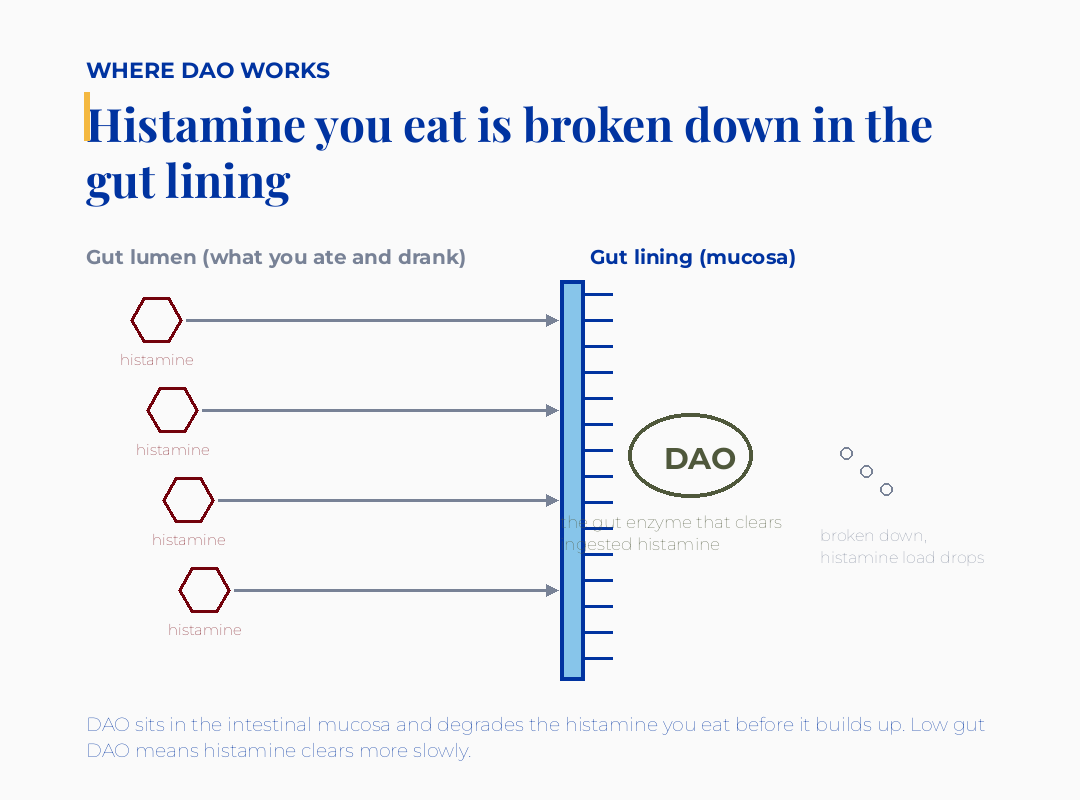
Quick translation before anything else. Histamine is a chemical your body makes and also eats in food. It runs your allergy responses, some of your stomach acid, and a few brain signals. DAO stands for diamine oxidase. It is the enzyme that clears the histamine you eat, and it does that work in the lining of your gut, not in your bloodstream and not on your hormone chart.
What conventional medicine misses about your flushing
Walk into most clinics with afternoon flushing, wine headaches, and random hives in your forties, and you get one of two answers. The first is that it is “just perimenopause,” filed next to the hot flashes and waved off. The second is a hormone panel that comes back “normal,” followed by the suggestion that you relax.
Here is what conventional medicine misses. Both answers skip the gut entirely. The naturopathic lens on this starts in a different place. Before I look at your hormones, I want to know what is happening in your intestinal lining, because that is where the enzyme that handles dietary histamine actually lives. The root cause is rarely “your estrogen dropped.” It is more often a gut that has lost some of its capacity to clear histamine, for reasons that have nothing to do with your hormone chart.
The short version: your symptoms are real, the histamine connection is real, but the first place to look is your gut, not a hormone panel.
What is DAO deficiency, in plain language?
DAO deficiency means your gut is not making enough diamine oxidase to keep up with the histamine you eat. When that enzyme runs low, histamine from food and drink builds up faster than your body clears it, and you feel it as flushing, headaches, hives, bloating, or that wired-but-tired anxiety after a high-histamine meal.
This is solid ground. DAO is the gut enzyme that clears the histamine you eat, and 80% of histamine-intolerant patients run low. That figure comes from a 2020 review of symptomatic patients, so it is a rate inside an already-suffering group, not a rate across all women. Still, the direction is clear and the mechanism has good support behind it.
Now the part the perimenopause posts rush past. DAO sits in your intestinal mucosa, meaning the inner wall of your gut. A glass of wine that “never used to bother you” now bothers you because alcohol both adds histamine and blocks the very enzyme that clears it. The wine did not change. Your gut’s clearing capacity did.
For the woman reading this with a headache after last night’s leftovers, that reframe matters. It moves the question from “what is wrong with my hormones” to “what is happening in my gut,” and the second question has answers you can actually act on.
Why does perimenopause get blamed for this?
The story you have heard goes like this. Estrogen drops in perimenopause, DAO drops with it, histamine floods, so buy the test and the capsule. It is tidy, it is repeatable, and it is mostly unproven in women your age.
I want to be generous here, because some of this holds up. The cyclical pattern is real. Many women genuinely feel worse in the back half of their cycle and during the perimenopausal swing. Estrogen and histamine do talk to each other in the body. That much is fair.
But the root-cause version of this question is harder than the posts admit. There is no DAO trial in perimenopausal women at all. And one piece of evidence runs straight against the tidy chain. In pregnancy DAO rises and 27 of 30 women’s histamine symptoms improved, breaking the low-estrogen story. Pregnancy is a high-estrogen state. If low estrogen always meant low DAO and worse symptoms, the highest-estrogen months of a woman’s life should be the worst. They are often the opposite.
So I hold the contradiction instead of forcing a tidy answer. The hormone shift is one input. It is not the whole engine, and the certainty being sold to you about it is not earned.
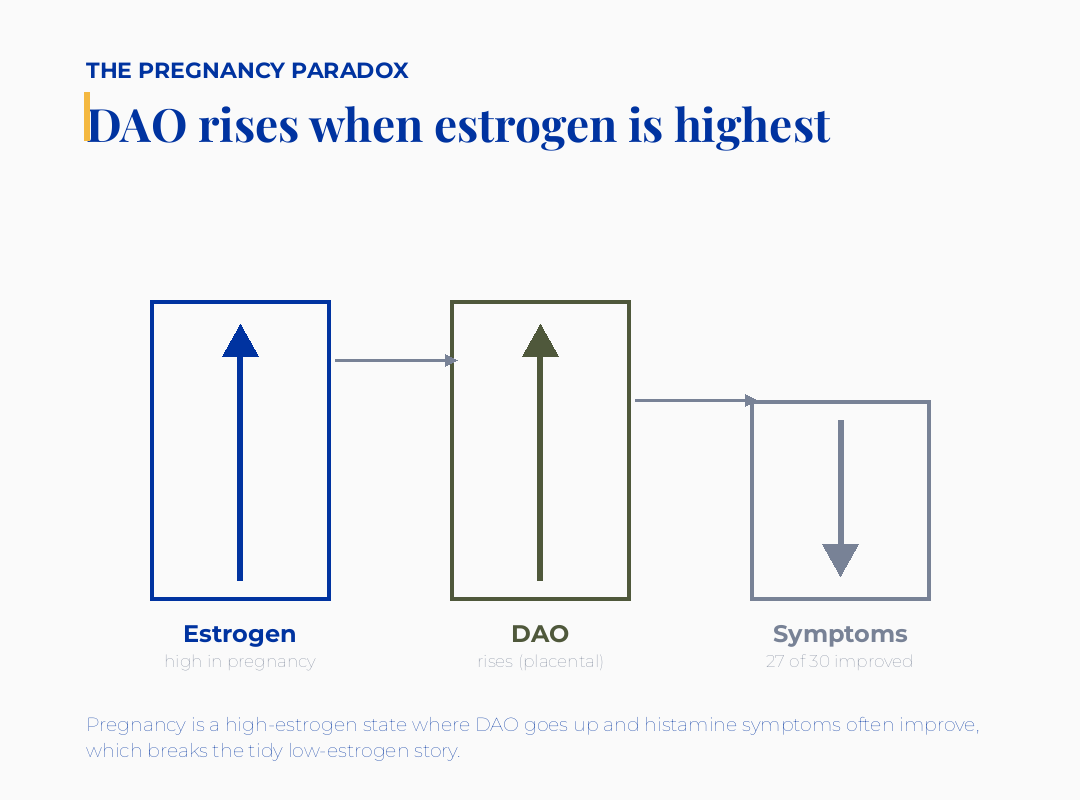
The takeaway here: the perimenopause-and-DAO link is plausible, not proven, and the pregnancy data are the reason a careful doctor refuses to oversell it.
Should you get the DAO blood test?
Short answer, no, not as a way to diagnose yourself. Save your money. A blood DAO level does not reflect the DAO activity in your gut lining, so a low number on a serum panel cannot confirm that you are deficient.
Let me translate the terms. Serum just means the liquid part of your blood after the cells are removed. A serum DAO test measures the enzyme floating in your blood. The problem is that the DAO doing the real work sits in your intestinal wall, and the blood level does not track with what is happening down there. The German-speaking allergy societies, who wrote the only formal guideline on this, say plainly that serum DAO alone is not diagnostic.
This is where I part ways with most of the content in your feed. The labs and brands selling a $200 DAO panel have a financial reason to call it a diagnosis. It is not one. It is one weak input, not an answer.
I worked through a case once, name changed for confidentiality of course, where a woman had spent close to three hundred dollars chasing serum DAO and a genetic panel before anyone asked her what she actually ate and drank. The numbers gave her a label. They did not give her a single thing she could do differently. That is the trap.
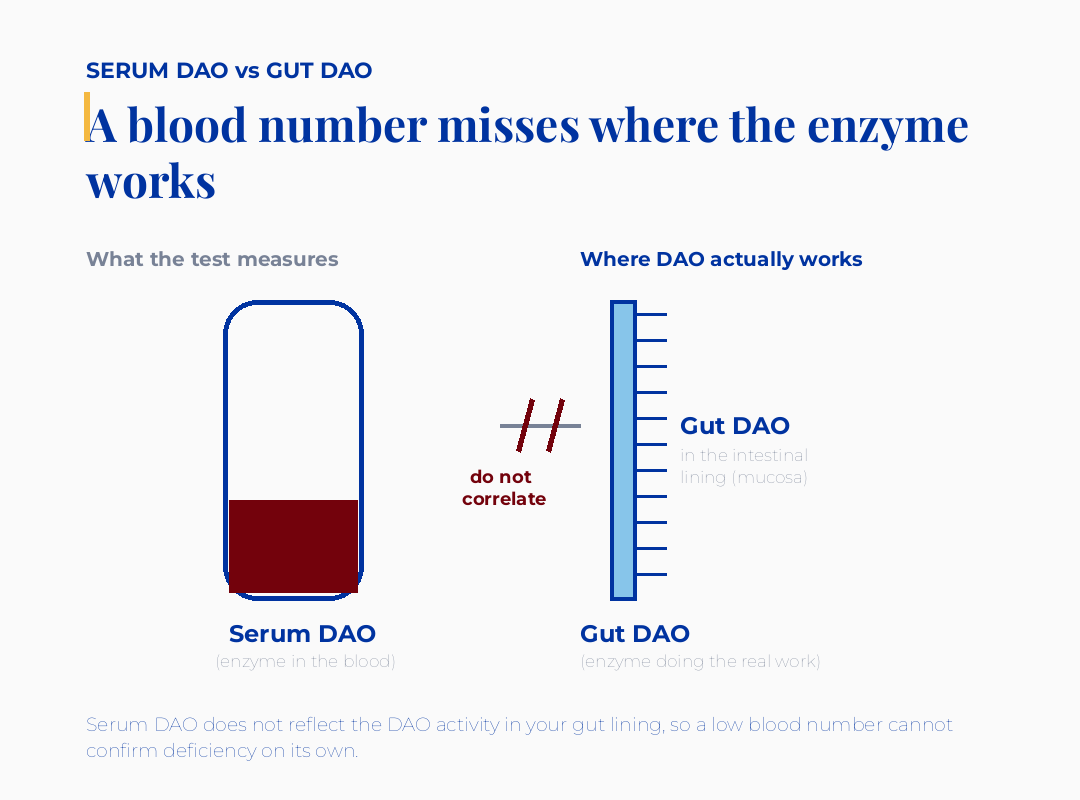
Bottom line on the test: a low serum DAO is one weak clue, never a diagnosis, and it is the one thing in this whole story I would tell you to stop paying for.
Where does DAO deficiency actually come from?
Start in the gut, because that is where the enzyme lives and where most of the real causes sit. The biggest drivers of low gut DAO are alcohol, frequent use of certain painkillers, a history of gut imbalance, and recent antibiotics. Notice that not one of those is on your hormone chart.
A few quick translations. NSAIDs are the common anti-inflammatory painkillers like ibuprofen and naproxen, and used often they can lower gut DAO. SIBO stands for small intestinal bacterial overgrowth, meaning too many bacteria setting up in the wrong part of your gut. Dysbiosis simply means your gut bacteria are out of their healthy balance. Each of these can drag down your gut’s histamine-clearing capacity.
This is the gut-pillar reframe, and it is the root cause the hormone posts skip. If you have a SIBO history, drink most nights, lean on ibuprofen, or just finished a course of antibiotics, you have a far more likely explanation for your symptoms than a single hormone reading. The naturopathic approach repairs the gut lining and reduces the histamine load first, then looks at hormones, not the other way around.
In cases I have reviewed, the women who got real relief were almost always the ones who addressed a gut input, not the ones who bought a capsule and changed nothing else. For the woman in front of me, that means the most useful first question is not “what are my estrogen levels,” it is “what is happening in my gut, and what is feeding the load.”
If your gut history is the missing piece, my deep dive on the SIBO subtypes and why it keeps coming back is worth your time, because a relapsing gut and a histamine problem are often the same story told twice. And if mold exposure is part of your picture, how mold drives a histamine load covers an input most perimenopause content never mentions.
The key point: DAO deficiency is usually a gut problem first, tied to alcohol, NSAIDs, SIBO, and antibiotics, which is exactly why the gut is where I would look before the hormone chart.
Does a DAO supplement actually work?
Sometimes, for a specific group, and that group has probably never been studied in women your age. Here is the honest read, and I am going to be generous with the evidence because it deserves it.
Two real double-blind trials came back positive. DAO supplements cut migraine hours in 100 patients with low DAO, not in those with normal levels. That comparator is the whole point. The benefit showed up in people with confirmed low baseline DAO, not in everyone who swallowed a capsule. A second trial in chronic hives found the same pattern. The people who improved were the ones who started out low, and the benefit shrank as baseline DAO rose.
So the supplement is not snake oil. It helped a defined subgroup in well-run studies. What it has not done is earn the broad “take this and your perimenopause histamine symptoms will lift” promise you see online. No trial enrolled perimenopausal women. And there is a quality problem worth naming, because at least one marketed pig-kidney DAO product, when tested in a lab, showed no measurable enzyme activity at all.
A note on how these capsules work, in plain terms. Most are made from porcine kidney, meaning pig kidney extract, which matters if you avoid pork. The idea is to add enzyme back into your gut right before a meal so it can break down the histamine in that food. Reasonable in theory. Proven only in narrow groups in practice.
For the woman considering a bottle, my read is this. If you want to try one, treat it as an experiment in the low-DAO, high-symptom group, not a cure, and do not let it replace the gut work that actually moves the needle.
The takeaway on capsules: real benefit, real studies, but only in confirmed low-DAO subgroups, never tested in perimenopause, and product quality is genuinely uneven.
What about the low-histamine diet?
This is the move I actually trust, and it is the one the guideline trusts too. A time-limited low-histamine diet, run for one to two months with foods added back in, is the most practical way to find out whether histamine is really your problem. Your own symptom response is the test, and it costs you nothing but attention.
Here is how it works in practice. You pull the high-histamine foods for a few weeks. Aged cheese, wine, cured meats, fermented foods, leftovers that have sat. You watch what happens. Then you add them back one at a time and watch again. If your flushing and headaches track with the food, you have your answer, and it is a more honest answer than any blood panel will give you.
One caution I will not skip. This diet is restrictive, and it is not meant to live on forever. Run it as a one-to-two-month trial, not a permanent lifestyle, because long-term restriction can drift into nutritional narrowing and an unhealthy relationship with food. The point is to learn something, then loosen.
For the woman who has been chasing a diagnosis for months, this is the reassuring part. You can start gathering real evidence about your own body this week, without a lab, without a prescription, and without spending a dollar.
The bottom line on diet: a short, time-limited low-histamine trial with reintroduction is the honest at-home test, and it beats the blood panel on both cost and usefulness.
What about my hormones and HRT, then?
I hear the worry underneath this question. You started HRT, meaning hormone replacement therapy, and your histamine symptoms got worse, and now you are wondering if your own treatment is turning on you. That experience is real, and women report it constantly. It is also exactly where I have to stay in my lane as an educator.
Estrogen and histamine do interact. Some women do react to an estrogen patch or to progesterone. But whether to start, stop, or adjust HRT is a decision for you and your prescriber, not something to fix with a supplement off a podcast. The histamine question and the hormone question are connected, and they still need different people in the room.
If you want the deeper mechanism on how estrogen, the gut, and your blood vessels tie together in this window, I walk through it in the estrogen-gut-vascular axis in perimenopause. And if your doctor has floated an antihistamine stack for these symptoms, what I make of the Pepcid and Claritin approach in perimenopause is the companion piece, since this topic is part of the perimenopause histamine series.
One firm boundary, because it matters. Histamine does not cause your hot flashes, and clearing histamine will not stop them. True hot flashes come from your brain’s temperature center, not from histamine. The flushing can look similar. They are not the same machinery, and I will not pretend otherwise.
The key point: the hormone-histamine link is real but tangled, HRT decisions belong with your prescriber, and histamine is not the cause of your hot flashes.
What I’d do this week
If this were happening to me, I would not start with a test or a capsule. I would start with my gut and my plate. Here is the exact sequence I would follow, and it is the one worth saving for your next appointment.
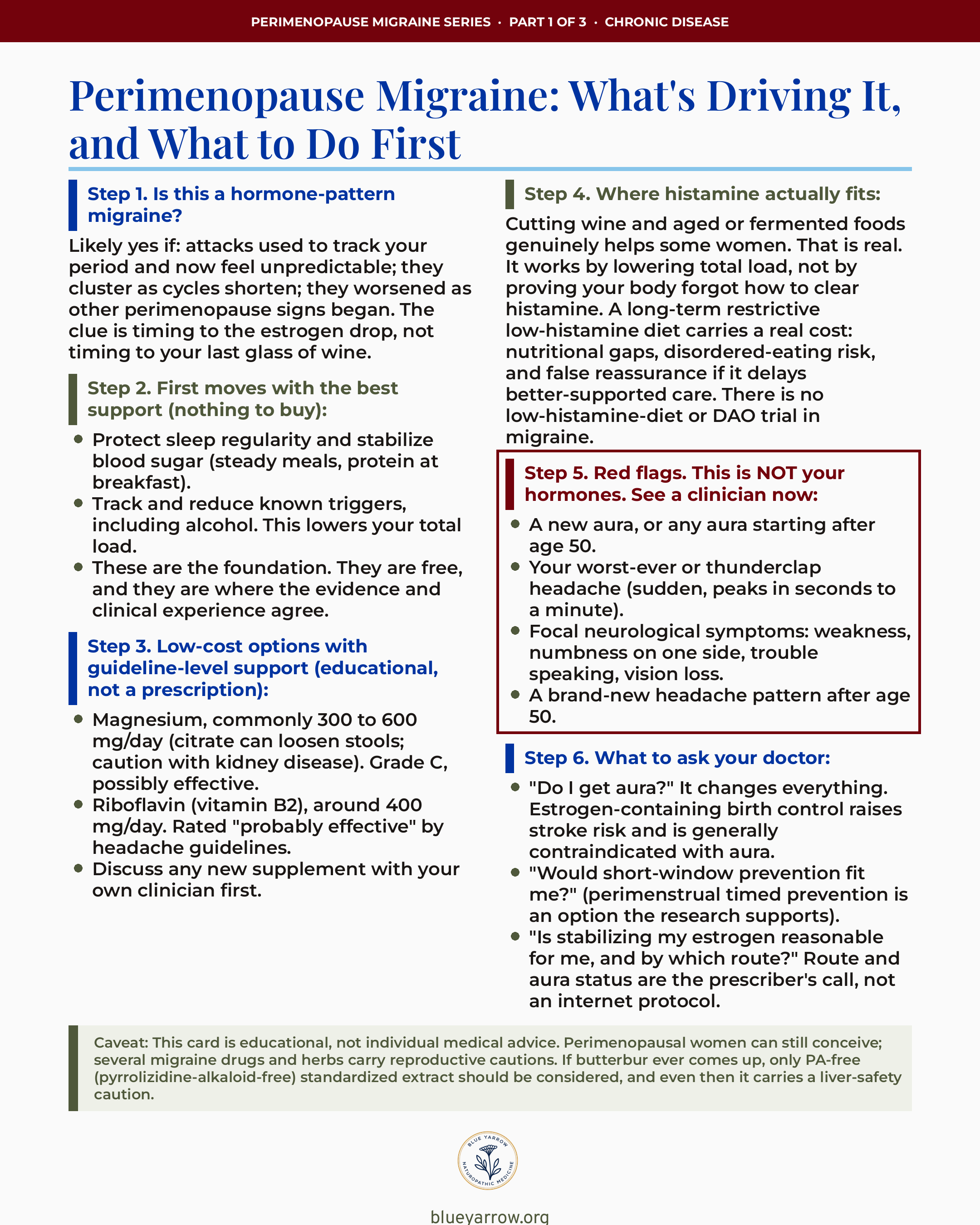
One more honesty note before you go. There is good evidence that most self-diagnosed histamine intolerance does not survive a blinded challenge, meaning a test where neither you nor the researcher knows if you got histamine or a placebo. In those studies, a large share of people reacted to the placebo. That does not mean your symptoms are fake. It means the food trial, done carefully, is a better truth-teller than your fear of the foods.
Frequently asked questions
Is the DAO blood test worth it? Not as a diagnosis. A serum DAO level does not reflect the enzyme activity in your gut lining, so a low number cannot confirm deficiency. The only formal allergy guideline says serum DAO alone is not diagnostic. A careful low-histamine food trial tells you more, for far less money.
Does low estrogen cause low DAO in perimenopause? It is a popular claim, but it is not proven in women your age, and one finding runs against it. In pregnancy, a high-estrogen state, DAO rises and most women’s histamine symptoms improve. The hormone shift may be one input, but it is not the clean cause the posts suggest.
Do DAO supplements actually work? In two small trials, yes, but only for people with confirmed low baseline DAO who had migraine or chronic hives. They were never studied in perimenopausal women. At least one marketed product showed no measurable enzyme in the lab, so quality is uneven and the broad promise is not earned.
Why does wine suddenly bother me in my forties? Alcohol does two things at once. It adds histamine and it blocks the gut enzyme that clears histamine. If your gut’s clearing capacity has dropped, the same glass that never bothered you can now trigger flushing and a headache. The drink did not change. Your gut did.
Can histamine intolerance cause my hot flashes? No. True hot flashes come from your brain’s temperature control center, not from histamine. The flushing from a histamine reaction can look similar, but it is different machinery. Clearing histamine will not stop hot flashes, and any product that promises it will is overselling.
Is this histamine intolerance or just perimenopause? It can be both, and a short low-histamine diet trial is the cleanest way to separate them. If your symptoms ease when you remove high-histamine foods and return when you add them back, histamine is part of your picture. If nothing changes, the cause is likely elsewhere.
This content is for educational purposes only and is not medical advice. Please consult with your healthcare provider for individual recommendations.
References
1. Comas-Basté, O., Sánchez-Pérez, S., Veciana-Nogués, M. T., Latorre-Moratalla, M., & Vidal-Carou, M. C. (2020). Histamine intolerance: The current state of the art. Biomolecules, 10(8), 1181. https://doi.org/10.3390/biom10081181
2. Schnedl, W. J., & Enko, D. (2021). Histamine intolerance originates in the gut. Nutrients, 13(4), 1262. https://doi.org/10.3390/nu13041262
3. Hrubisko, M., et al. (2021). Histamine intolerance: The more we know the less we know. A review. Nutrients, 13(7), 2228. https://doi.org/10.3390/nu13072228
4. Jochum, C. (2024). Histamine intolerance: Symptoms, diagnosis, and beyond. Nutrients, 16(8), 1219. https://doi.org/10.3390/nu16081219
5. Jiménez-Rodríguez, A., et al. (2025). Diamine oxidase deficiency: Implications for health, current management, and future directions. International Journal of Biological Macromolecules. https://doi.org/10.1016/j.ijbiomac.2025.147130
6. Izquierdo-Casas, J., et al. (2018). Diamine oxidase (DAO) supplement reduces headache in episodic migraine patients with DAO deficiency: A randomized double-blind trial. Clinical Nutrition, 38(1), 152-158. https://doi.org/10.1016/j.clnu.2018.01.013
7. Yacoub, M. R., et al. (2018). Diamine oxidase supplementation in chronic spontaneous urticaria: A randomized, double-blind placebo-controlled study. International Archives of Allergy and Immunology, 176(3-4), 268-271. https://doi.org/10.1159/000488142
8. Duelo, A., et al. (2024). Study protocol: Low-histamine diet and DAO enzyme supplementation in patients with histamine intolerance. Nutrients, 17(1), 29. https://doi.org/10.3390/nu17010029
9. Improvement of histamine intolerance symptoms in pregnant women with diamine oxidase deficiency. (2025). Journal of Clinical Medicine, 14(13), 4573. https://doi.org/10.3390/jcm14134573
10. Effects of histamine and diamine oxidase activities on pregnancy. (2008). PMID 18499706.
11. Evaluation of porcine diamine oxidase for the conversion of histamine. (2020). PMID 32090335.
12. DGAKI, GPA, AeDA, SGAI, ÖGAI. (2021). Guideline on management of suspected adverse reactions to ingested histamine. PMC8511827.
